
What if I told you the secret to school readiness wasn’t teaching children to sit still, follow routines, write their name, count to 20, be “good at listening”, or put their shoes on independently?
Science tells us something very different. The real foundations of school readiness aren’t found in checklists or early academics. They are found in the deeper developmental systems that help children regulate emotions, think flexibly, communicate, and connect with others.
School readiness is something that develops from the inside out.
And at the heart of that development is one powerful driver:
PRETEND PLAY
Yes, pretend play. And here’s why.…
Pretend play is one of the strongest predictors of a child’s social, emotional, and language development.
Research shows that children with stronger pretend play skills at ages 2-3 had fewer emotional and behavioural difficulties at ages 4-5 and again at 6-7.
These children had:
- better emotional regulation
- fewer behavioural challenges
- stronger social skills
- improved cognitive flexibility
What exactly is pretend play?
Pretend play is the ability to use imagination to create roles, stories, and symbolic meanings. It’s a developmental process that begins in toddlerhood and becomes increasingly complex over the preschool years, forming the foundation for emotional regulation, social skills, language, and flexible thinking.
But it’s important to recognise that not all pretend play is the same. Some play looks imaginative on the surface, but it sits at the earlier, simpler levels of pretend play development. Children might be dressed up, holding figurines, or playing with themed toys – but unless they are creating a storyline, taking on a role, or using objects symbolically, they aren’t yet engaging in rich pretend play.
Also, a child pushing buttons, spinning wheels, lining things up, or exploring how a toy works is engaging in exploratory or functional play. These forms of play are still valuable. They help children learn how the world works – but they are not pretend play.
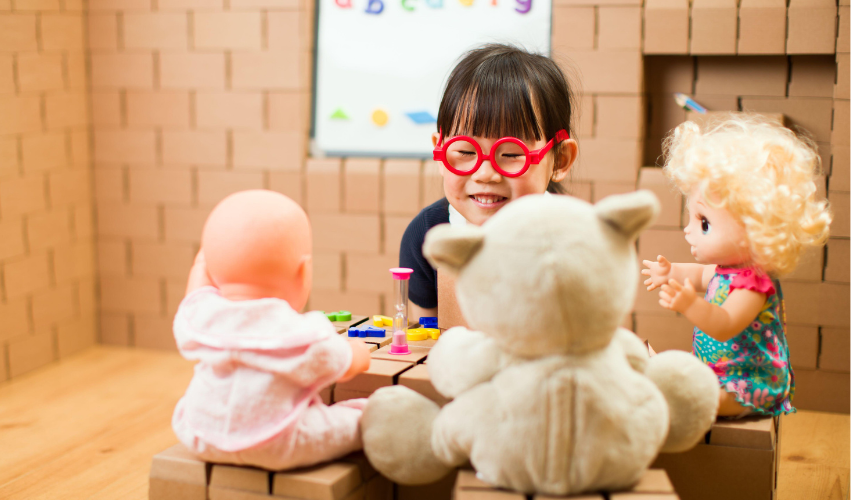
Rich pretend play only begins when a child adds imagination or symbolic meaning: when the block becomes a cake, the stick becomes a wand, or the child becomes the doctor caring for a sick teddy. And it’s this richer, more complex pretend play that builds the deep developmental foundations children need for school readiness.
How does pretend play build school readiness?
Pretend play isn’t “just play.” It is the brain’s natural training ground for the exact skills children need to thrive in a classroom.
1. Emotional regulation
Research shows that children with well developed pretend play demonstrate better self‑regulation, because play allows them to practise big feelings safely.
2. Flexible thinking
Pretend play requires children to shift perspectives, transform objects, and adapt storylines – the same cognitive flexibility needed for problem solving and coping with change at school.
3. Working memory
To stay in a role or follow a play script, children must hold ideas in mind. This is foundational for following instructions and learning routines.
4. Language and narrative skills
Research shows that pretend play is strongly linked to expressive language, storytelling, and comprehension. As children’s pretend play becomes more complex, their language typically grows alongside it – they use richer vocabulary, longer sentences, and more detailed narratives to sustain their play. Improvements in pretend play skills often lead to improvements in communication because children must organise ideas, negotiate roles, and express their thoughts clearly to keep the story going.
5. Social understanding
Role play and animating characters builds perspective taking – the early roots of empathy and Theory of Mind. Children learn to negotiate, collaborate, and understand others’ intentions.
These are the skills that help children:
- cope with transitions
- build friendships
- follow group instructions
- manage frustration
- stay engaged in learning
The Hidden Foundations of School Readiness (Built Through Play)
While school readiness checklists focus on surface skills (sitting still, following routines, recognising letters, managing belongings) – these abilities don’t emerge in isolation. They rest on deeper developmental foundations that cannot be fast‑tracked or drilled. Without well developed pretend play, many of the checklist items simply don’t stick, because children don’t yet have the emotional regulation, flexible thinking, language organisation, social understanding or executive functioning required to carry them out. When pretend play is strong, those “readiness skills” appear naturally and reliably, not because they were taught, but because the child has the internal architecture to use them.
How to Support the Development of Pretend Play
Children don’t magically develop pretend play. It grows in stages, and many children today are 2-3 years behind in their pretend play development – even those who attend daycare and playgroups. Research across several countries now confirms what many educators and therapists have been noticing for years: pretend play has significantly declined over the past two decades.
Evidence of this decline includes:
- Research from Cambridge University highlights a significant decline in children’s opportunities for free and imaginative play over recent decades, driven by increased urbanisation, reduced unstructured time, and rising academic pressure.
- A 2023 EducationHQ article reports that Australian children are experiencing a decline in imaginative and unstructured play, driven by increased screen time, overscheduling, and safety concerns.
- Karen Stagnitti, Australia’s leading researcher in pretend play development, notes that many children are now entering school with limited ability to create a storyline, take on roles, or sustain imaginative play — skills that were once developmentally typical.
For more information…
For more information and resources to support children and pretend play:
- Workshop for Early Educators – facilitated by Playful minds on Executive Function and Pretend Play Development
- Free Book- Pretending with Objects by Karen Stagnitti – ideas for using everyday objects as symbols in play.
- Free Book – The Children are Home by Karen Stagnitti – play ideas for children at home
- OT Article Pretend Play Developmental Milestones – developmental milestones and play skills used in pretend play
- Nurturing Creativity and Innovation: The Power of Pretend Play
Article by Play Matters on how to support pretend play in children
What are some signs a child may need extra support with pretend play and school readiness?
Every child develops at their own pace, but sometimes the skills needed for pretend play (and the deeper foundations of school readiness) need a little extra support. Because pretend play underpins emotional regulation, social confidence, flexible thinking, and communication, gaps in play often show up as the very challenges that make the transition to school feel harder.
Some signs to look out for include:
- Big emotional reactions or frequent meltdowns
- Anxiety in social settings
- Not socially aware
- Withdrawal from others or finding friendships challenging
- Unsure how to get started with play or what to do
- Find it hard to stay engaged in play, especially with peers
- Prefer to play alone or finding group play overwhelming
- Want to control play or needing to direct what happens
- Become easily frustrated during play or frequently disrupting play scenes
- Avoid pretend play altogether and gravitate only to active, functional, or repetitive play
- Delayed expressive or receptive language
🌼 A Note From Me…
As a play therapist, I see firsthand what the research shows: pretend play is one of the most powerful developmental tools we have.
When we protect it, nurture it, and value it, children flourish – emotionally, socially, and academically.
School readiness isn’t about pushing children into early academics. It’s about giving them the developmental foundations to thrive.
And those foundations are built through one thing:
Play. Real, rich, imaginative play.
If you are curious about your child’s pretend play skills, or have concerns about their development – this is exactly the work I do at Playful Minds. Please reach out here

Renee Irving Lee
APPTA registered Child Play Therapist (TM)
Master of Child Play Therapy | Grad Cert Positive Psychology | BEd(Special Education)
Other Playful Minds Articles….

How to Support a Child to Develop Emotional Regulation
Discover how children develop emotional regulation through body awareness, emotional understanding, theory of mind, and co‑regulation. Learn practical ways caregivers can support healthy emotional development.


Why does Play Therapy work better than teaching strategies?
Teaching strategies often fail when children are dysregulated. Play therapy works because it engages the whole brain, builds regulation through connection, and creates effortless repetition inside meaningful play.

A Parent’s Checklist for Understanding Challenging Behaviour
When behaviour becomes challenging, it can feel overwhelming to figure out what’s really going on. Maslow’s Hierarchy of Needs offers a simple, structured way to look beneath the surface. The model explains that children can only access higher‑level skills like emotional regulation, cooperation, and problem‑solving when their foundational needs are supported. By working through the…

Preparing Your Child for a Medical Procedure: A Calm, Practical Guide for Parents
Preparing a child for a medical procedure can feel daunting, but the right support can make the experience calmer and more predictable for both parent and child. When adults feel informed and grounded, children naturally borrow that sense of safety. This guide walks you through practical ways to prepare yourself, help your child understand what…

Why Sharing Is So Hard for Children (and How We Can Support Them)
Sharing looks simple from the outside, but for children it’s a deeply complex developmental skill. It asks them to regulate their bodies, understand another person’s perspective, and let go of something that feels precious or even part of themselves. In this article, we explore why sharing is so hard for children, and how gentle, supportive…

Helping Children Take Medicine: A Playful, Connected Approach
Learn why children refuse medicine and how to help them take it calmly and confidently. Includes playful techniques and guidance for children with medical trauma.

The Three Relationships That Shape School Refusal in Early Childhood
School refusal and separation anxiety in early childhood often stem from three key relationships in a child’s world: their connection with school, their home environment, and their relationship with themselves. When these areas are supported, children separate more confidently.

Understanding Toileting Challenges in Children
Many children find toileting unexpectedly hard. Sensory needs, emotions, past discomfort, and developmental readiness all play a role – and with the right support, things can get easier.

The Emotional Work of Bedtime: Understanding Children’s Sleep Needs
Child sleep difficulties are common and can impact behaviour, learning, and emotional regulation. This blog explains the causes of sleep struggles, what signs to look for, and practical, evidence‑based strategies to support healthy sleep in children.

Play Therapy: A Guide for Sunshine Coast Parents
Is your child experiencing big feelings or behaviour changes? Play therapy helps children express themselves through play – learn how it works and how it can support your child on the Sunshine Coast.
Leave a Reply