
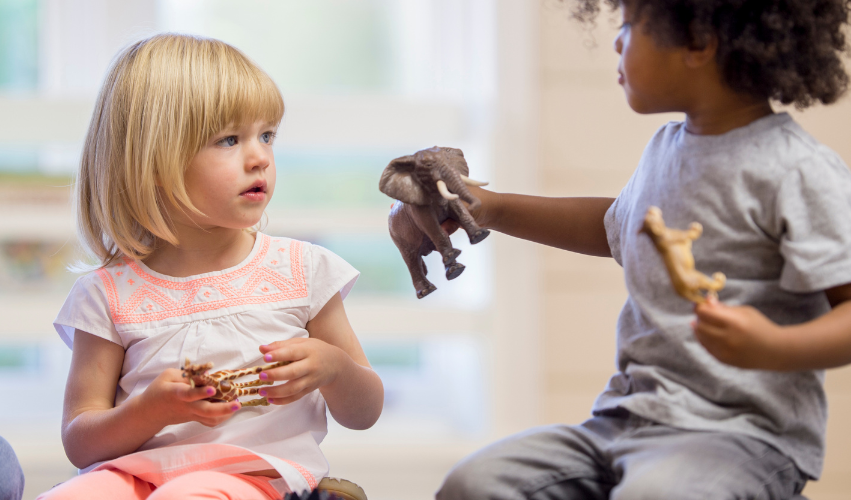
Sharing is such a valuable, lifelong skill, but it’s also one of the hardest for children to learn. It asks a lot of them: self regulation, communication, patience, empathy, and the ability to hold someone else’s needs alongside their own. That’s a huge developmental load.
Here are some reasons why sharing can feel so challenging:
1. “My toys are part of me.”
Young children often see the things they are holding or playing with as an extension of themselves. When another child reaches for a toy, it can feel, quite literally, like someone is taking a piece of them. Their sense of ownership and identity is still forming.
2. They are still developing theory of mind.
Children under 4–5 years old are naturally egocentric. They are not yet developmentally ready to fully understand that other people have different thoughts, feelings, and intentions. Sharing requires that awareness, so it’s no wonder it’s tough.
3. The endowment effect is real.
The endowment effect tells us that children (and adults too) find an object more valuable if they own it, so it becomes harder for them to share their own toys. This is why it is more difficult to host a playdate at your own house! Children are better at sharing objects that don’t belong to them.
4. Their nervous system might be overwhelmed.
If a child is tired, overstimulated, sick, hungry, frustrated, or emotionally full, their capacity to share drops dramatically. Sharing requires regulation, and regulation requires a regulated body.
5. Their nervous system may go into “threat mode.”
This is the piece we often forget. When another child grabs a toy or reaches for something they are using, a child’s nervous system can interpret it as a threat. Not a dangerous threat – but a threat to control, safety, predictability, or autonomy. Their body reacts before their thinking brain has a chance to catch up. You might see:
• snatching back
• yelling “NO!”
• pushing or pulling
• freezing or shutting down
This is a protective response. Their brain is doing exactly what it’s designed to do when something feels taken from them.
6. They have reached their sharing quota for the day.
Children share far more than we realise – attention, space, time, parents, routines. Sometimes they have simply had enough.
7. New or special toys feel extra precious.
If a toy is new or deeply loved, they may need time to fully explore it before they are ready to let someone else have a turn.
8. Older children care deeply about fairness.
As kids grow, their sense of justice sharpens. They may resist sharing if they feel the situation isn’t fair or balanced.
So how do we actually teach children to share?
Sharing is a skill that grows slowly, with lots of modelling and support. Here are some gentle, practical ways to help:
Give them a heads up
Before playdates or group activities, talk about what sharing might look like and how many children will be there. Predictability helps regulation.
Let them choose what they are willing to share
Children don’t have to share everything. Ask: “Which toys are your special toys, and which ones are your sharing toys?” Special toys can be put away before visitors arrive. This simple step prevents so many meltdowns.
Support them with scripts
If another child wants a turn, you can help them say: “These are my special toys and I’m playing with them right now, but you can play with these ones instead.”
Model sharing yourself
Children learn to share by being on the receiving end of sharing. When adults share time, space, attention, and objects with them, they build an internal template for what sharing feels like — and that template becomes the foundation for sharing with peers.
Play turn taking games
Board games, rolling balls + passing objects to each other – all of these build the foundations of sharing in low stakes ways. These reciprocal, back‑and‑forth games help children internalise the idea that play and objects can flow between two people, not just stay with one.
Acknowledge sharing when you see it
Not praise – just noticing. “You handed the truck to Sam so he could have a turn.” Or “You figured out a way for both of you to use the truck.”
Read books about sharing
Stories help children explore tricky concepts safely and playfully.
For groups of children, try the Montessori playmat approach
Each child has their own playmat which becomes their “sacred play space.” Toys on the mat belong to that child until they invite someone in. Toys off the mats are communal. This gives clear boundaries, autonomy, and choice.
🌼 A Note From Me…
Children learn sharing through relationship, not instruction. Before they can share with others, they need repeated experiences of others sharing with them — time, space, attention, and play.
In the Playful Minds playroom, reciprocity is one of the most powerful therapeutic processes we can utilise: the back‑and‑forth rhythm of connection that helps children feel seen and valued. When we model that rhythm in everyday life, children begin to internalise it. Sharing becomes something they feel, not something that they have to perform.

Renee Irving Lee
APPTA registered Child Play Therapist (TM)
Master of Child Play Therapy | Grad Cert Positive Psychology | BEd(Special Education)
Other Playful Minds Articles….

How to Support a Child to Develop Emotional Regulation
Discover how children develop emotional regulation through body awareness, emotional understanding, theory of mind, and co‑regulation. Learn practical ways caregivers can support healthy emotional development.


Why does Play Therapy work better than teaching strategies?
Teaching strategies often fail when children are dysregulated. Play therapy works because it engages the whole brain, builds regulation through connection, and creates effortless repetition inside meaningful play.

A Parent’s Checklist for Understanding Challenging Behaviour
When behaviour becomes challenging, it can feel overwhelming to figure out what’s really going on. Maslow’s Hierarchy of Needs offers a simple, structured way to look beneath the surface. The model explains that children can only access higher‑level skills like emotional regulation, cooperation, and problem‑solving when their foundational needs are supported. By working through the…

Preparing Your Child for a Medical Procedure: A Calm, Practical Guide for Parents
Preparing a child for a medical procedure can feel daunting, but the right support can make the experience calmer and more predictable for both parent and child. When adults feel informed and grounded, children naturally borrow that sense of safety. This guide walks you through practical ways to prepare yourself, help your child understand what…

Helping Children Take Medicine: A Playful, Connected Approach
Learn why children refuse medicine and how to help them take it calmly and confidently. Includes playful techniques and guidance for children with medical trauma.

The Three Relationships That Shape School Refusal in Early Childhood
School refusal and separation anxiety in early childhood often stem from three key relationships in a child’s world: their connection with school, their home environment, and their relationship with themselves. When these areas are supported, children separate more confidently.

The Science of School Readiness: Rethinking What It Really Means to Be School Ready
A science‑backed look at what school readiness really requires – and why pretend play builds the developmental foundations children need far more than any checklist.

Understanding Toileting Challenges in Children
Many children find toileting unexpectedly hard. Sensory needs, emotions, past discomfort, and developmental readiness all play a role – and with the right support, things can get easier.

The Emotional Work of Bedtime: Understanding Children’s Sleep Needs
Child sleep difficulties are common and can impact behaviour, learning, and emotional regulation. This blog explains the causes of sleep struggles, what signs to look for, and practical, evidence‑based strategies to support healthy sleep in children.

Play Therapy: A Guide for Sunshine Coast Parents
Is your child experiencing big feelings or behaviour changes? Play therapy helps children express themselves through play – learn how it works and how it can support your child on the Sunshine Coast.
Leave a Reply