
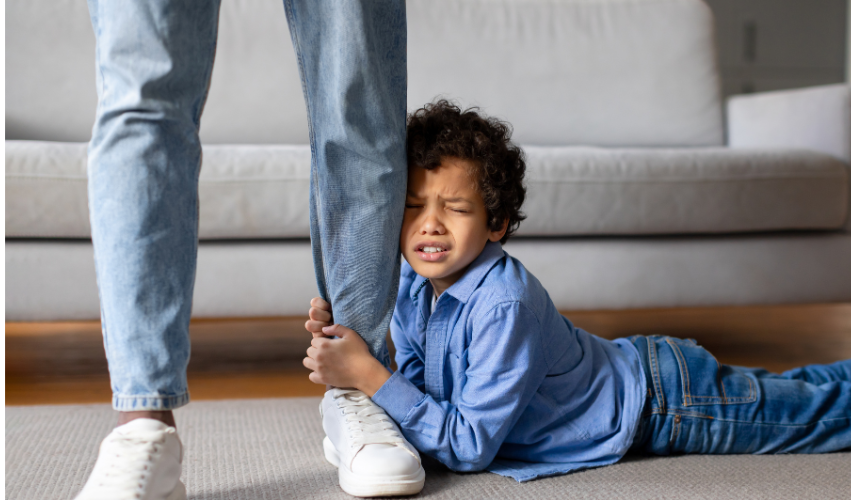
School refusal and separation anxiety in early childhood are rarely caused by one single factor. They emerge from a relationship system around the child – a web of connections, expectations, and emotional cues that shape how safe and confident they feel when stepping away from their parent or home environment. When one part of that system feels uncertain, the child’s ability to separate can become more challenging. For some children, the challenge is about the environment feeling unfamiliar. For others, it’s about the parent–child dynamic during drop-off. And for many, it’s about their own developing sense of capability, resilience, and emotional regulation.
Understanding school refusal through this relational lens helps us move away from seeing it as “behaviour” and instead recognise it as communication: the child is signalling that something in their world needs changing.
A helpful way to respond is to look closely at three key relationships that need nurturing:
- The child’s relationship with the kindy/school environment
- The child’s relationship with home, family, and parents
- The child’s relationship with themself
When these three relationships feel secure, predictable, and supported, children gain the confidence they need to separate well. Strengthening them creates the emotional scaffolding that allows a child to walk into kindy or school with a steadier nervous system, a clearer sense of safety, and a growing belief in their own capability.
1. The child’s relationship with the kindy/school environment
The first relationship to explore is the child’s connection with their kindy or school environment. This is where their sense of safety, belonging, and predictability begins -and it plays a major role in how they manage separation.
This includes:
- Their connection with teachers, educators, support staff, and peers
- Their relationship with the routines, expectations, and systems
- Their sense of safety and comfort in the physical environment
What might be driving the difficulty?
- A mismatch between the child’s temperament and the classroom structure
- Feeling unsure about peers or social dynamics
- Sensory overload or environmental stressors
- Not yet having a strong attachment figure at kindy
- Transitions that feel too fast, unpredictable, or overwhelming
2. The child’s relationship with home, family, and parents
Children borrow the emotional climate of their home. The way mornings unfold, the level of predictability at home, the parent’s nervous system, and the overall family rhythm all shape how prepared a child feels to separate. When home feels calm, consistent, and emotionally safe, children arrive at kindy with a steadier foundation.
This includes:
- The parent’s emotional state during drop-off and throughout the morning
- The family’s morning routine, pace, and level of predictability
- Sleep quality and bedtime consistency
- Screen use before school and its impact on regulation
- The parent’s beliefs and expectations about kindy/school
- The level of congruence between what the parent says and what the child sees
- The parent’s ability to hold boundaries while offering warmth and reassurance
- The overall emotional climate at home (stress, conflict, transitions, changes)
What might be driving the difficulty?
- The parent feeling anxious, guilty, or unsure about leaving the child
- Mixed messages (e.g., overhearing a parent speak negatively about the school or kindy and feeling confused about why they are still being sent; or hearing a parent say “you’ll be OK” while the parent themselves appears anxious and worried at drop‑off)
- A rushed, chaotic, or stressful morning routine
- Poor sleep or inconsistent bedtime routines leading to fatigue and dysregulation
- Screen use before school affecting mood, attention, and transitions
- The parent unintentionally rescuing the child from discomfort
- The child sensing the parent’s hesitation or emotional discomfort
- Family stressors (illness, conflict, big changes, new sibling, separation)
- The parent’s own past experiences with school or separation influencing their reactions
- A lack of alignment between home strategies and kindy strategies
- The child feeling more secure at home than in the school environment, making separation feel like a loss
3. The child’s relationship with themself
This is the heart of resilience. Children need to feel capable, brave, and supported – not rescued from every discomfort. Their internal relationship shapes how they respond to challenge, how they interpret stress, and how confidently they can step into new environments. When children trust themselves, separation becomes far less overwhelming.
This includes:
- The child’s developing sense of capability and independence
- Their ability to name, understand, and regulate emotions
- Their confidence in trying new things, even when worried
- Their belief that they can cope with discomfort and recover
- Their internal narrative (“I can do hard things”, “I’m safe”, “I can try again”)
- Their emerging problem‑solving skills and resilience
What might be driving the difficulty?
- Developmental factors (e.g., temperament, sensory sensitivity, anxiety traits)
- A low sense of confidence or self-belief
- Difficulty regulating emotions during transitions
- Feeling overwhelmed by big feelings without tools to manage them
- A tendency to avoid discomfort rather than work through it
- Past experiences that have shaped a “I can’t do this” narrative
- Limited opportunities to practise bravery in small, supported ways
- A strong reliance on adults to soothe, solve, or rescue
For more information…
For more information and resources on school refusal and kindy separation anxiety:
Playful Minds – Article “The Science of School Readiness: Rethinking What It Really Means to be School Ready”
Triple P Parenting – FREE online course “ Coping with fear, anxiety and strong emotions”
Triple P Parenting – Article “No more tears: Parenting tips for easier drop-offs”
School Can’t Australia – Resources and support groups for parents of children with school attendance difficulties
Happy Families – Article by Dr Justin Coulson “school refusal”
🌼 A Note From Me…
When we look at school refusal and separation anxiety through a relational lens, one thing becomes very clear: all three relationships need nurturing for a child to separate confidently. A child might have a beautiful bond with their teacher, but if mornings at home feel rushed or emotionally charged, separation will still be hard. Likewise, a calm and predictable home routine won’t fully support a child if their relationship with the school environment feels overwhelming or unfamiliar. And even when both home and school are doing everything “right,” a child’s internal relationship (their confidence, emotional regulation, and sense of capability) also needs to be actively supported over time.
These three relationships work together like a small ecosystem. When one part is under strain, the whole system feels it. When all three are supported, children step into kindy with a steadier nervous system, clearer expectations, and a growing belief that they can do hard things.
This is where play therapy can make a meaningful difference.
Play therapy supports the child’s internal world, their emotions, confidence, coping skills, and sense of self. Through play, children learn to understand their feelings, practise bravery in small manageable steps, and build the emotional tools they need to handle separation, transitions, and new environments. It also strengthens the parent–child relationship by helping parents understand their child’s cues, respond in attuned ways, and create predictable rhythms at home that support separation.
In my work, I also collaborate closely with kindy and school teams. When home, school, and the child’s internal world are aligned, we see the biggest shifts. Play therapy becomes the bridge that connects these relationships, helping children feel safe enough, confident enough, and supported enough to walk into kindy with a calmer body and a braver heart.
If your child is struggling with separation or school refusal, you don’t have to navigate it alone. Play therapy offers a gentle, developmentally appropriate pathway to strengthen all three relationships – and help your child feel ready to start their school day with confidence.

Renee Irving Lee
APPTA registered Child Play Therapist (TM)
Master of Child Play Therapy | Grad Cert Positive Psychology | BEd(Special Education)
Other Playful Minds Articles….
Term 4: Spots Available
If you’re wondering whether your child is ready for big school or might benefit from another year in kindy, this page walks you through the core skills that matter most — and how Playful Minds help children build them.


Early Intervention: Why Starting Early Matters More Than You Think
Early intervention provides timely support during the most important years of brain development, helping children build healthier patterns that shape their future wellbeing.

How to Support a Child to Develop Emotional Regulation
Discover how children develop emotional regulation through body awareness, emotional understanding, theory of mind, and co‑regulation. Learn practical ways caregivers can support healthy emotional development.

Why does Play Therapy work better than teaching strategies?
Teaching strategies often fail when children are dysregulated. Play therapy works because it engages the whole brain, builds regulation through connection, and creates effortless repetition inside meaningful play.

A Parent’s Checklist for Understanding Challenging Behaviour
When behaviour becomes challenging, it can feel overwhelming to figure out what’s really going on. Maslow’s Hierarchy of Needs offers a simple, structured way to look beneath the surface. The model explains that children can only access higher‑level skills like emotional regulation, cooperation, and problem‑solving when their foundational needs are supported. By working through the…

Preparing Your Child for a Medical Procedure: A Calm, Practical Guide for Parents
Preparing a child for a medical procedure can feel daunting, but the right support can make the experience calmer and more predictable for both parent and child. When adults feel informed and grounded, children naturally borrow that sense of safety. This guide walks you through practical ways to prepare yourself, help your child understand what…

Why Sharing Is So Hard for Children (and How We Can Support Them)
Sharing looks simple from the outside, but for children it’s a deeply complex developmental skill. It asks them to regulate their bodies, understand another person’s perspective, and let go of something that feels precious or even part of themselves. In this article, we explore why sharing is so hard for children, and how gentle, supportive…

Helping Children Take Medicine: A Playful, Connected Approach
Learn why children refuse medicine and how to help them take it calmly and confidently. Includes playful techniques and guidance for children with medical trauma.

The Science of School Readiness: Rethinking What It Really Means to Be School Ready
A science‑backed look at what school readiness really requires – and why pretend play builds the developmental foundations children need far more than any checklist.

Understanding Toileting Challenges in Children
Many children find toileting unexpectedly hard. Sensory needs, emotions, past discomfort, and developmental readiness all play a role – and with the right support, things can get easier.
Leave a Reply